Morleigh Kor

By on 10 Mar ’12

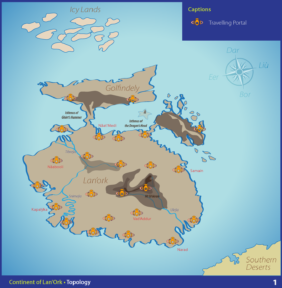
Morleigh Kor:  Also known as The Marshes of Doom, this territory is characterized by its expansive marshes and swamps, with tribes residing on inner islands.

The inhabitants follow a shamanic system close to nature, akin to Earth’s aboriginal Australians’ songlines.

Temporary marriages are common, allowing cross-tribal unions. Thirty-seven tribes, each with specialized houses representing various trades or skills, exist. House and tribal affiliations are inherited matrilineally. The Shaman house, independent of the tribes, receives support from all and adopts new members through an adoption process.

Continue Reading

E’elim

By on

E’elims are an ancient race currently living on the Duane. Very few people know of their existence and even among the Guardians, they were mostly regarded as a myth.

In fact, she wasn’t a lady or a human at all. She was an E’elim, as they called their race when they had use for words. Their true form wasn’t really physical, and their existence was mostly ignored — a fact that was not a small feat, for even the ancient race of the Guardians mostly didn’t know of them at the time when they were in the system of Alienor. In fact, their consciousness was quite different from the rest of the races, and in many ways, it was one of the most ancient one, having been present for countless ages.
They’d known the times of the appearance of the third moon around Duane.
They had even witnessed the emergence of that third planet, which is now mostly forgotten, but was then called B’si before it was called Phreal by the Guardians.
And they were there at the time of the separation of the Great Panye into the twin planets now known as Duane and Murtuane. The E’elims where riders of the elements; usually only one of the six elements from which everything stemmed: airs, earths, woods, flames, waters, and forgotten (or spirit).


Continue Reading

Fudjàh

By on

The six Fudjàhs are power objects associated with the Hexades.

The Fudjàhs were thought to be powerful artifacts; but contrary to common belief, even if the artifacts had indeed some special configuration and effects, they weren’t powerful in themselves, but only in association to the proper being wielding them.

It is probable that other and lesser versions and variations existed, but only the few listed below are known to have lasted.

Another common misconstruction is that there were only a unique copy of each. It is for instance well documented among the Turmaki that there were for instance many versions of the “key of Ghört”, even if the one usually referred to was that of the Jokan of that name. Similarly, the Unguent of Nærvel is more a recipe of a blend of special biological compounds than it is an actual unguent.

List of Known Fudjàhs

Sunstone of Agnima, Cup of Margilonia, Unguent of Nærvel, Wand of Selvaniel, Mirror of Lejüs, Key of Ghört

See also: Alienomancians, Léonard
Continue Reading

Three Wise Men

By on

The figures of the Three Wise Men are part of the folklore of all the Kingdoms of Lan’ork.

Though the associated myths often are changed or distorted.

As an example, they were associated with a triad of colors in Landgurdy, Aton and Furgha (Era of Twelve, Era of Seven)

Their is apparently not one origin, and the figures had been mixed and blended to others throughout history and with trade.

Possible origins:

  • a triad of Alienomancians
  • 3 of the kings of Landgurdy said to become a triad after their death
  • 3 unknown guardians (to be determined)
  • maybe an association with the 3 planets of Alienor, the youngest of the three men being the Phrëal

Continue Reading

Alienor Eras

By on

A work in progress, as we continue to document the main events having occurred or occurring on Alienor and its three main planets.

Era of the Guardians

  • Sinadron experiments with inserting non native to the Murtuane, this starts to stir the balancing effect of the Murtuane over the Duane.
  • Georges replaces Shu-Lum at the Jokan Council.
  • Salome and Cil travel to the Murtuane sent by Nah’Rom to investigate on the uprisings.
  • This era ends with the phasing of the Phrëal and the assassination of Vogel
  • New races appear: Dragons and Nirguals. They are a sort of energetic rearrangement of the Guardians who wanted to stay respectively either on the Duane or on the Murtuane.

Era of the Warring Kingdoms

Note: The number added to the Era is usually a count of the main remaining Kingdoms at the end of the Era. During the Era, the figure is usually irrelevant, as much movement of the boundaries can occur.

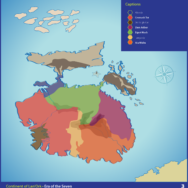
Era of the Twelve

* During the period where the ancient Guardians have disappeared, the control they had being relinquished led to battles in order to secure power on the main continent of Lan’ork. The continent is under the rule of warlords and feudal ruling that leaves the continent split into twelve main regions.
* The dragons vanish from sight; it is prophesied they would reappear when troubles have settle down and peace would be about to dawn.
* Åsgurdy destroys their traveling portals in a religious war that leads them to be effectively cut off from the Western part. As the generations grow, the knowledge of what lies beyond the Great Rift remains only with a few.

Era of the Seven

* Abduction of Atiara of Landgurdy, who will later be known as the Weaving Princess, she is kept in the Marshes of Doom
* Lola finds a dragon egg. Against all odds, the dragon (Asiir) hatches and they bond. — the egg was inserted as the result of a time-traveling experiment of Leörmn, Malvina and the guests in their rookery.
* Atiara is rescued and the ensuing battle marks the end of the Era.
* Reactivation of the traveling portals.
* At the end of the Great War, The Marshes of Doom region, as well as Langurdy regain their status of semi-autonomous regions.

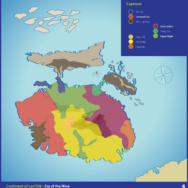
Era of the Nine

This area marks the return of the traveling portals technology, and the reappearance of dragons on the Duane.

* Dragons are starting to reappear
* The reactivation of portals make conquest more easy, and the kingdoms are once again split into many.
* The Orange Prince and the vassals: one of the Kingdom’s King, “Paul” (originated from Earth) abdicates in favor of his son, named Paul (Dumian) too. The son is plotting to gain control over his rivals. One of his plan involves marrying a dark-haired princess, Uhaollis. The princess suspects she is only a chess piece in Paul II’s game, but is forced by her mother, the blond Sylvania to comply. The Orange flag of the Kingdom becomes stitched with a white border as a representation of each conquered vassals…

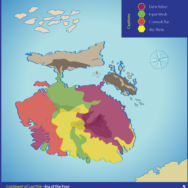
Era of the Four

Most of the timeline of Malvina occurs during this period. It marks a period where dragons are starting to become more commonplace, but are not always welcome.

The four left Kingdoms on Lan’ork are:

  • Erpet Mesh (green)
  • Ata Meliu (yellow)
  • Cromash Tur (red)
  • Dam Adbor (purple)
  • Malvina and her sisters are trained on the Dragon’s birth place, the Island of Mörk.
  • Roselÿn decides to go settle her rookery in Åsgurdy, to start reinserting the old knowledge, and preparing the continent to be reunited.
  • Bådul bridges the Great Rift and starts exploring the Western World, unknown yet to Åsgurdians.


Continue Reading